Gammalkilsvägen 18, 590 53, Ulrika, Sweden         communication@iaamonline.org           (+46) 13 13 24 24           WeChat: iaamEU           WhatsApp: (+46) 706 722 524

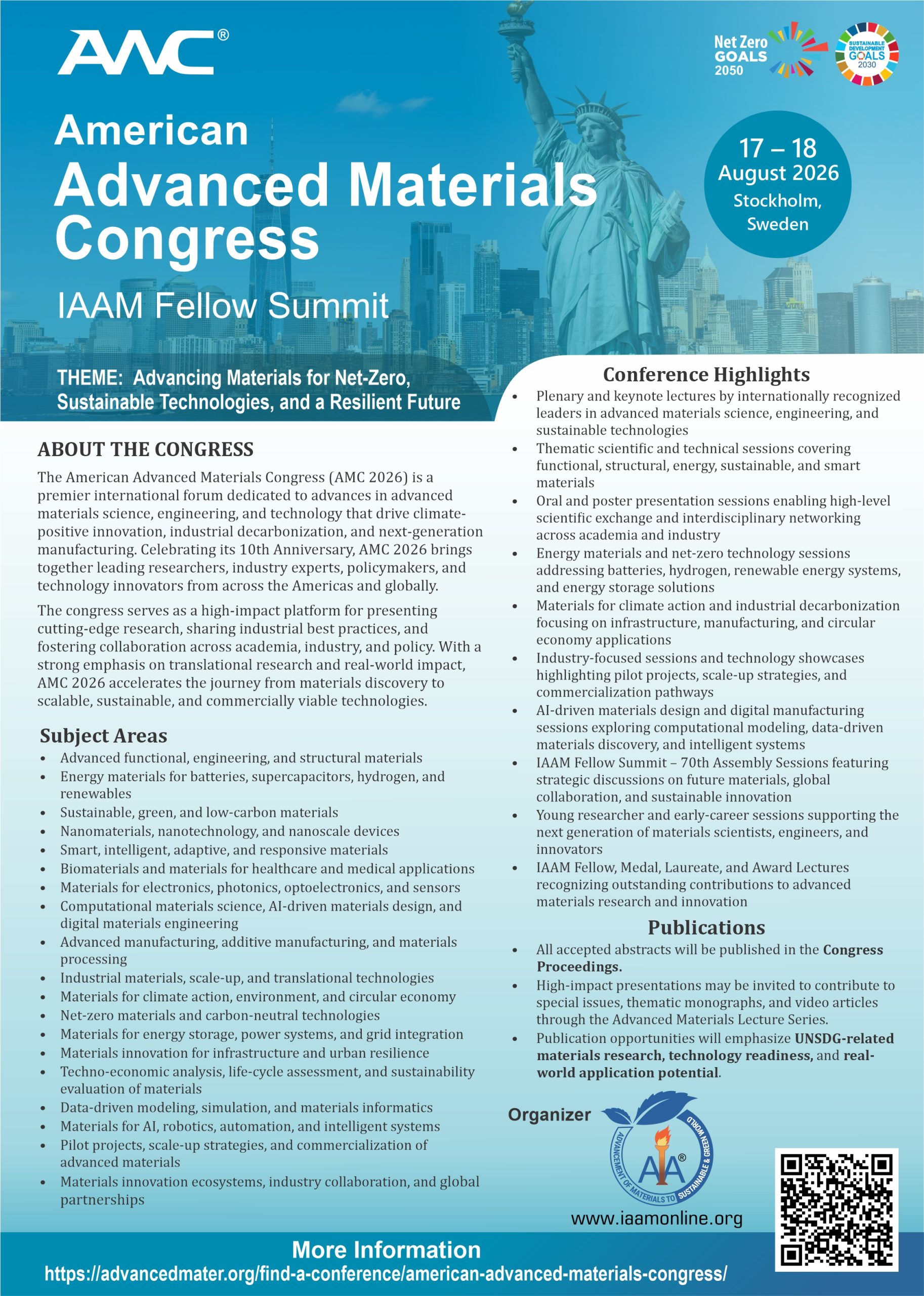
The American Advanced Materials Congress (AMC 2026) is a premier international forum dedicated to advances in advanced materials science, engineering, and technology that drive climate-positive innovation, industrial decarbonization, and next-generation manufacturing. Celebrating its 10th Anniversary, AMC 2026 brings together leading researchers, industry experts, policymakers, and technology innovators from across the Americas and globally.

The congress serves as a high-impact platform for presenting cutting-edge research, sharing industrial best practices, and fostering collaboration across academia, industry, and policy. With a strong emphasis on translational research and real-world impact, AMC 2026 accelerates the journey from materials discovery to scalable, sustainable, and commercially viable technologies.

Conference Theme

Advancing Materials for Net-Zero, Sustainable Technologies, and a Resilient Future

The conference theme highlights the central role of advanced materials in enabling climate-neutral technologies, resilient infrastructure, clean energy systems, and circular industrial ecosystems. AMC 2026 focuses on materials innovation that supports Net-Zero Goals 2050 and the UN Sustainable Development Goals (SDGs).

Key thematic directions include next-generation functional and structural materials, energy and storage materials, sustainable and green materials, AI-driven materials design, advanced manufacturing, and materials solutions for climate, environment, and circular economy. Through interdisciplinary dialogue and global collaboration, AMC 2026 aims to translate materials science excellence into tangible solutions for a sustainable and resilient future.

Subject Areas

The American Advanced Materials Congress (AMC 2026) will cover,
but is not limited to, the following subject areas:

  • Advanced functional, engineering, and structural materials
  • Energy materials for batteries, supercapacitors, hydrogen, and renewables
  • Sustainable, green, and low-carbon materials
  • Nanomaterials, nanotechnology, and nanoscale devices
  • Smart, intelligent, adaptive, and responsive materials
  • Biomaterials and materials for healthcare and medical applications
  • Materials for electronics, photonics, optoelectronics, and sensors
  • Computational materials science, AI-driven materials design, and digital materials engineering
  • Advanced manufacturing, additive manufacturing, and materials processing
  • Industrial materials, scale-up, and translational technologies
  • Materials for climate action, environment, and circular economy
  • Net-zero materials and carbon-neutral technologies
  • Materials for energy storage, power systems, and grid integration
  • Materials innovation for infrastructure and urban resilience
  • Techno-economic analysis, life-cycle assessment, and sustainability evaluation of materials
  • Data-driven modeling, simulation, and materials informatics
  • Materials for AI, robotics, automation, and intelligent systems
  • Pilot projects, scale-up strategies, and commercialization of advanced materials
  • Materials innovation ecosystems, industry collaboration, and global partnerships

Conference deadlines

Abstract Submission Deadline: 30 April 2026

Notification of Acceptance: 15 May 2026

Early-bird Registration Deadline: 15 June 2026

Registration Deadline: 31 July 2026

Conference Highlights

  • Plenary and keynote lectures by internationally recognized leaders in advanced materials science, engineering, and sustainable technologies
  • Thematic scientific and technical sessions covering functional, structural, energy, sustainable, and smart materials
  • Oral and poster presentation sessions enabling high-level scientific exchange and interdisciplinary networking across academia and industry
  • Energy materials and net-zero technology sessions addressing batteries, hydrogen, renewable energy systems, and energy storage solutions
  • Materials for climate action and industrial decarbonization focusing on infrastructure, manufacturing, and circular economy applications
  • Industry-focused sessions and technology showcases highlighting pilot projects, scale-up strategies, and commercialization pathways
  • AI-driven materials design and digital manufacturing sessions exploring computational modeling, data-driven materials discovery, and intelligent systems
  • IAAM Fellow Summit – 70th Assembly Sessions featuring strategic discussions on future materials, global collaboration, and sustainable innovation
  • Young researcher and early-career sessions supporting the next generation of materials scientists, engineers, and innovators
  • IAAM Fellow, Medal, Laureate, and Award Lectures recognizing outstanding contributions to advanced materials research and innovation

Our UNSDGs Commitments

In alignment with the United Nations Sustainable Development Goals (UNSDGs), the American Advanced Materials Congress (AMC 2026) is committed to advancing sustainable materials innovation, responsible industrial development, and global collaboration through the following goals:

SDG 7

Affordable and Clean Energy

Promoting advanced materials for clean energy generation, energy storage, hydrogen systems, and low-carbon technologies to support reliable and sustainable energy solutions.

SDG 9

Industry, Innovation and Infrastructure

Advancing materials science to enable resilient infrastructure, smart manufacturing, and industrial innovation across key technology sectors.

SDG 11

Sustainable Cities and Communities

Supporting materials innovation for sustainable infrastructure, urban resilience, clean mobility, and climate-adaptive built environments.

SDG 12

Responsible Consumption and Production

Encouraging circular economy approaches, resource-efficient materials, sustainable manufacturing, and life-cycle assessment practices.

SDG 13

Climate Action

Enabling materials-based solutions for decarbonization, emission reduction, and climate-resilient technologies aligned with global net-zero targets.

SDG 17

Partnerships for the Goals

Strengthening international collaboration among academia, industry, policymakers, and innovation ecosystems to accelerate sustainable development.

A Decade of Impact

Over the past ten years, the American Advanced Materials Congress (AMC) has grown into a leading international platform advancing materials science, engineering, and technology across the Americas and globally. Since its inception, AMC has played a pivotal role in connecting academia, industry, and policy communities, fostering interdisciplinary collaboration and accelerating innovation in advanced materials.

Throughout the decade, AMC has supported the translation of fundamental materials research into real-world applications, enabling technological solutions for energy transition, industrial decarbonization, sustainable manufacturing, healthcare, and infrastructure resilience. By bringing together global experts, decision-makers, and innovators, the congress has helped bridge the gap between laboratory discovery and industrial deployment.

AMC’s impact extends beyond scientific exchange. The congress has actively contributed to global sustainability agendas, aligning materials innovation with the UN Sustainable Development Goals (SDGs 2030) and Net-Zero Goals 2050. Through strategic dialogue, high-level scientific sessions, and international cooperation, AMC has strengthened innovation ecosystems and promoted responsible, climate-positive technologies.

As AMC celebrates its 10th Anniversary in 2026, the congress reflects on a decade of excellence, collaboration, and progress—while setting a forward-looking vision for the next generation of advanced materials that will shape a sustainable, resilient, and technologically advanced future.

Congress Reports 

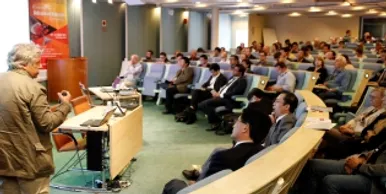
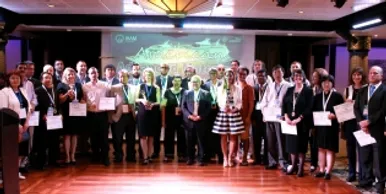
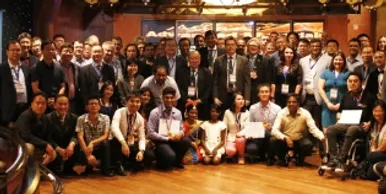
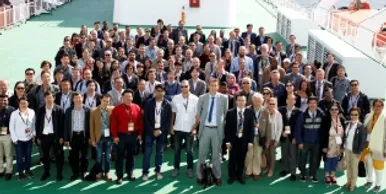
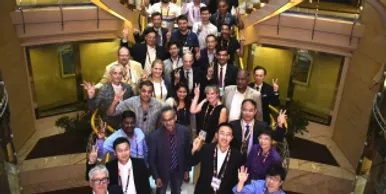
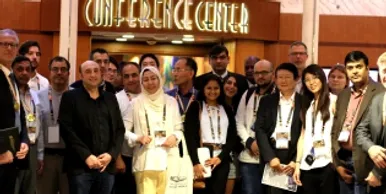
Since 2011, the Advanced Materials Congress has held over 60 assemblies across Asia, Europe, the USA, and Australia.

Scroll to top